
Scientists Use Intratumoral Immunotherapy To Tame Pancreatic Cancer
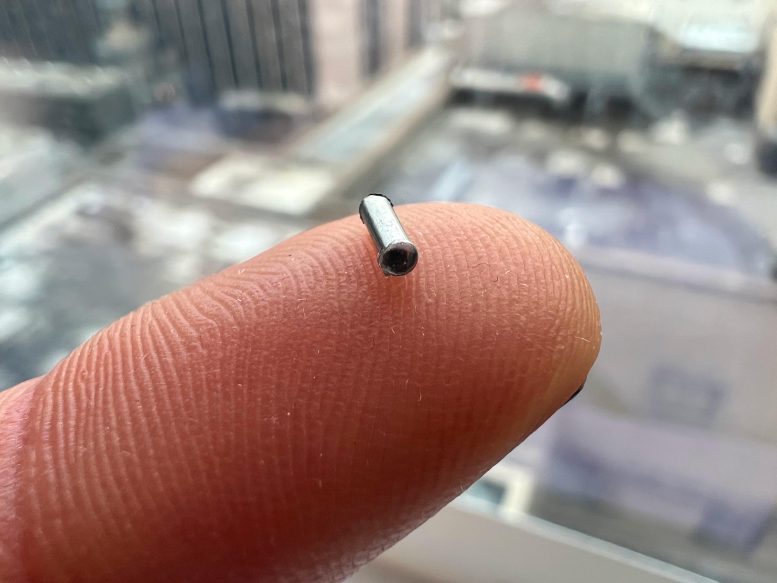
Houston Methodist nanomedicine researchers have discovered a method to control pancreatic cancer, a highly aggressive and challenging form of the disease, by administering immunotherapy directly to the tumor using a device smaller than a grain of rice.
A recent study published in the journal Advanced Science details the work of researchers from the Houston Methodist Research Institute who utilized an implantable nanofluidic device of their own creation to deliver CD40 monoclonal antibodies (mAb), a highly promising immunotherapeutic agent, in a sustained low dose via the nanofluidic drug-eluting seed (NDES). The results, as observed in mice models, showed a significant reduction in tumor size at a four times lower dosage compared to conventional systemic immunotherapy treatments.
“One of the most exciting findings was that even though the NDES device was only inserted in one of two tumors in the same animal model, we noted shrinkage in the tumor without the device,” said Corrine Ying Xuan Chua, Ph.D., co-corresponding author and assistant professor of nanomedicine at Houston Methodist Academic Institute. “This means that local treatment with immunotherapy was able to activate the immune response to target other tumors. In fact, one animal model remained tumor-free for the 100-days of continued observation.”
Pancreatic ductal adenocarcinoma is frequently diagnosed at advanced stages. In fact, about 85% of patients already have metastatic disease at diagnosis.
The Houston Methodist researchers are studying similar nanofluidic delivery technology on the International Space Station. Grattoni’s nanomedicine lab at Houston Methodist focuses on implantable nanofluidics-based platforms for controlled and long-term drug delivery and cell transplantation to treat chronic diseases.
Advantages Over Conventional Systemic Immunotherapy
Immunotherapy holds promise in treating cancers that previously did not have good treatment options. However, because immunotherapy is delivered throughout the entire body, it causes many side effects that are sometimes long-lasting, if not life-long. By focusing the delivery directly into the tumor, the body is protected from being exposed to toxic drugs and has fewer side effects, essentially allowing patients undergoing treatment to have a better quality of life.
“Our goal is to transform the way cancer is treated. We see this device as a viable approach to penetrating the pancreatic tumor in a minimally invasive and effective manner, allowing for a more focused therapy using less medication,” said Alessandro Grattoni, Ph.D., co-corresponding author and chair of the Department of Nanomedicine at Houston Methodist Research Institute.
The NDES device consists of a stainless-steel drug reservoir containing nanochannels, thus creating a membrane that allows for sustained diffusion when the drug is released.
Other medical technology companies offer intratumoral drug-eluting implants for cancer therapeutics, but those are intended for shorter-duration use. The Houston Methodist nanofluidic device is intended for long-term controlled and sustained release, avoiding repeated systemic treatment that often leads to adverse side effects.
Additional lab research is underway to determine the effectiveness and safety of this delivery technology, but researchers would like to see this become a viable option for cancer patients in the next five years.
Reference: “Sustained Intratumoral Administration of Agonist CD40 Antibody Overcomes Immunosuppressive Tumor Microenvironment in Pancreatic Cancer” by Hsuan-Chen Liu, Daniel Davila Gonzalez, Dixita Ishani Viswanath, Robin Shae Vander Pol, Shani Zakiya Saunders, Nicola Di Trani, Yitian Xu, Junjun Zheng, Shu-Hsia Chen, Corrine Ying Xuan Chua and Alessandro Grattoni, 19 January 2023, Advanced Science.
DOI: 10.1002/advs.202206873
The study was funded by the Golfers Against Cancer and the National Institutes of Health.
Never miss a breakthrough: Join the SciTechDaily newsletter.
Follow us on Google and Google News.